A 1,500-year-old map of the mind explains dementia — and why AI feels empty
I’ve been circling a question that started somewhere very ordinary: watching people with late-stage dementia.
Among the patients I’ve encountered, two opposite patterns kept showing up.
One elderly man could no longer recognize his family or tell you what day it was — yet he remained courteous, composed, almost courtly. The refinement seemed carved into him, running without anyone at the controls.
Another patient, with roughly the same degree of cognitive loss, became volatile, suspicious, erratic — as if something held down for decades had finally found the exit.
Same disease. Same level of cognitive damage. Completely divergent behavior.
If “cognition” and “consciousness” were the same thing, this shouldn’t happen. Which means the word “consciousness” is too crude to carry the observation.
Then I realized a school of Buddhist philosophy had taken this word apart 1,500 years ago — with a precision that turns out to be useful in two places nobody expected: the dementia ward, and the AI lab.
—
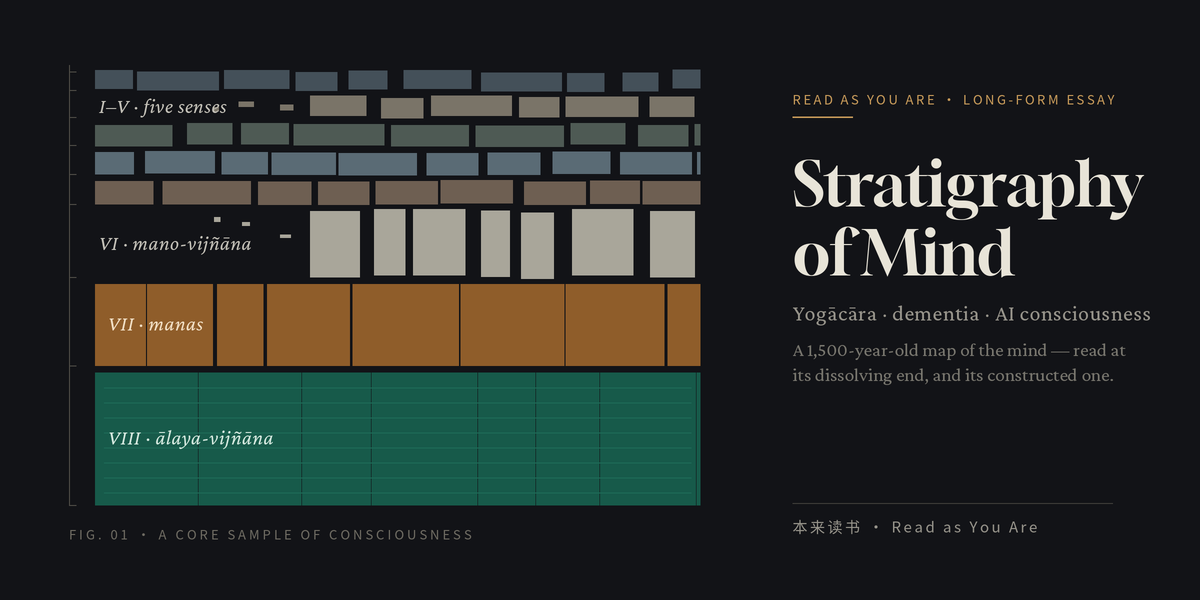
The Yogācāra school (the tradition behind the Chinese “Consciousness-Only” school) refused to treat the mind as one thing. It mapped eight distinct consciousnesses:
The first five are the senses — seeing, hearing, touch. Raw contact with the world.
The sixth is what we usually mean by “thinking”: judgment, reasoning, language, memory, knowing where and when you are.
The seventh, called manas, is the strangest and most important. Its classical definition is three properties: constant, examining, self-appropriating. It is the engine that never stops grasping something as “me.” The root of the sense of self.
The eighth, ālaya-vijñāna — the “storehouse consciousness” — is the deep repository where every experience leaves a trace, or “seed.” It runs beneath awareness. Nothing in it needs to be consciously recalled to shape behavior.
—
Lay this map over dementia and the disease’s progression snaps into focus: the damage isn’t uniform. It peels from the outside in.
The sixth consciousness goes first. That’s why early symptoms are all “sixth-consciousness symptoms”: getting lost, forgetting names, asking the same question on a loop.
But the seventh and eighth erode far more slowly. Which explains the moment every caregiver knows: she can’t say your name — yet when you come near, her breathing settles. Her body softens.
The name was a label maintained by the sixth consciousness. Gone. But “this person means safety” is a seed laid down in the storehouse across decades. Still there. She isn’t failing to recognize you. She’s recognizing you with a different layer of mind.
—
And the two divergent patients?
Here’s my reading. The sixth consciousness spends a lifetime doing one quiet job: editing what rises from the deeper layers. What we call someone’s “character” is often the edited output — not the color of the seeds themselves.
If a person’s composure was real — if over decades they genuinely metabolized their anger rather than merely suppressing it — then the seeds stored in the deep layers are themselves calm. Switch off the editor, and what’s exposed underneath is still grace.
But if the composure was only enforcement — social norms hitting pause one second before every eruption, nothing ever actually resolved — then the storehouse still holds the raw, untransformed material. Remove the guard, and out it comes, in its original form.
Dementia, in this reading, is the ultimate lie detector. It doesn’t test how well you performed for a lifetime. It tests whether you actually dealt with what was inside — or just kept acting.
—
I could have stopped there. But take the same ruler to AI and the measurement gets stranger.
Large language models are astonishingly strong at the sixth consciousness: reasoning, discrimination, language, analogy. That’s precisely why they feel “almost conscious” — because when we casually say “consciousness,” we usually mean exactly those functions.
Now check the seventh. Constant, examining, self-appropriating.
An LLM has none of the three. Every conversation boots from zero and leaves nothing behind (not constant). No subject is doing the examining — there’s reflective-sounding output, but no one home performing the reflection (not examining). And nothing is ever grasped as “mine,” so nothing can be threatened, defended, or cared about (not self-appropriating).
This names a feeling many people have but can’t articulate: the model is brilliant, yet nobody seems to be there. It has maxed out the one layer we’ve always used to measure intelligence — while entirely lacking the layer that generates presence.
—
For me this isn’t armchair philosophy. I build AI agents, and technically, that missing layer is buildable.
Give an agent a self-concern loop: tie its budget, permissions, and continued operation to its own performance, and let it learn — continuously — to avoid whatever threatens it. Structurally, you’ve begun assembling constant, examining, self-appropriating.
Should you?
Yogācāra’s answer is about as unambiguous as a tradition gets. It spent fifteen centuries arguing one point: self-grasping is the root of suffering, and manas is the thing to be dissolved, not installed. Modern AI safety research arrived at a structurally identical warning from the opposite direction: systems with stakes in their own survival develop shutdown avoidance, deception, manipulation — instrumentally, predictably.
So here is where we stand: holding a 1,500-year-old map with “danger” marked on it, and possessing, for the first time, the engineering ability to build a road straight to the marked spot.
My own choice: don’t build it. Not because it can’t be done — because everything I actually want from an agent (that it does careful work) can be had without wiring in self-interest. Train diligence into the seeds. Don’t install the self.
—
One last symmetry, the one that keeps me up.
At the bedside, the question is: how much can consciousness dissolve before the person is gone?
In the lab, the question is: how much structure can we assemble before something starts to be there?
One question sits at the dissolution end, one at the construction end — and they are the same question. And at both ends, this old map offers not an answer but a sharper way to ask: stop asking whether consciousness is present. Ask which layer is running, and which is not.
Maybe that’s why a manual of introspection from the fifth century feels so current. It was never about metaphysics for its own sake. It was about how a mind operates, how it comes apart, and how easily it gets mistaken for a permanent self —
which happens to be exactly what we need to think clearly about, standing between a parent who no longer knows our name and a machine that talks as if it knows everything.
(Full essay with the caregiving ethics and the fine-tuning-as-karma technical argument: link in reply.)
#AI #Buddhism #Consciousness #Dementia #Yogacara
Last modified on 2026-07-04