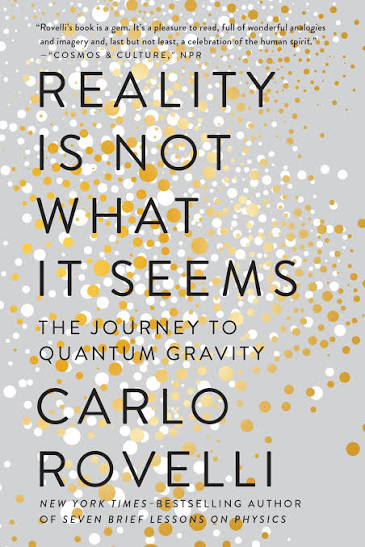
— On Carlo Rovelli’s Reality Is Not What It Seems
Every morning we wake up, two things seem to need no proof.
First, that “I” am still here — that the person I was yesterday and the person I am today are one and the same. Second, that another night has passed — that time kept flowing while I slept, as it always does, without pause or reversal.
These two convictions feel so immediate, so fundamental, that we never think to question them. They are the bedrock on which we build everything else.
Carlo Rovelli is an Italian theoretical physicist and one of the founders of loop quantum gravity. In Reality Is Not What It Seems, he dismantles both of these foundations — with uncommon elegance.
I. Time Is Not a Container. It Is a Byproduct.
In Newton’s universe, time is the backdrop — a uniformly flowing river in which all things unfold. Einstein shattered this picture: time bends under gravity. A clock at sea level runs slower than one on a mountaintop. Twin brothers, one living by the ocean and one in the mountains, would find themselves at slightly different ages if they compared notes years later. This is not a metaphor. It has been measured.
But Rovelli goes further still.
Within the framework of loop quantum gravity, when we quantize both space and time, something strange emerges: the equations describing the fundamental state of the universe contain no time variable.
This is not a mathematical shortcut. It is a profound physical conclusion. At the most basic level, the universe has no external clock ticking away. There is no universal “now” shared by all things. Time, as a fundamental physical quantity, does not exist.
So what is the passage of time that we experience?
Rovelli’s answer comes from thermodynamics. He calls it the “thermal time hypothesis”: our sense of time is a product of the fact that we can only perceive macroscopic averages.
We are too small. We will never see a single particle, never perceive a single quantum of space. What we see are stones, mountains, the faces of friends — each one an averaged effect of countless elementary components. Heat is the name we give to our ignorance of these microscopic states. Heat dissipates, and dissipation is irreversible. Irreversibility creates a direction. That direction is what we call the arrow of time.
In Rovelli’s own words: time is information we do not have.
That sentence deserves a pause. We do not exist inside time. We perceive time because of what we do not know.
II. No Objects. Only Relations.
Beyond time, Rovelli dismantles the concept of “objects” with equal thoroughness.
Quantum mechanics has long carried an unresolved interpretive problem: what state is a particle in before it is observed? The Copenhagen interpretation says it has no definite state — only probabilities. The many-worlds interpretation says each observation splits reality into parallel universes.
Rovelli proposes a relational interpretation: the state of a particle is only defined relative to the other systems with which it interacts. There is no absolute, observer-independent physical reality.
And the deeper conclusion is this: it is not that things enter into relations. It is that relations give rise to the notion of things.
In the world quantum mechanics describes, there are no isolated entities. There are only interactions, events, networks of relations. A stone, in Rovelli’s view, is a process — quantum vibrations maintaining their structure for a while, like a wave on the ocean that holds its shape before dissolving back into the sea.
We, too, are such processes.
III. From Physics to the Human Condition
At this point I find myself stepping away from physics and toward a question closer to daily life.
If time does not exist at the fundamental level, where does our anxiety about time come from? If the “self” is not a stable entity but an ongoing process within a web of relations, what does our compulsion to maintain a fixed self-image actually mean?
Behavioral science offers a concept called status quo bias — the tendency to prefer the current state of affairs and resist change. It is typically explained as an extension of loss aversion: change means losing something we already have.
But Rovelli’s physics suggests a deeper layer. Perhaps we resist change because we are instinctively protecting a narrative — a story about a stable, continuous self that persists through time. And that narrative, viewed from the perspective of physics, is a macroscopic approximation: an illusion produced by our nervous systems averaging over countless microscopic interactions.
We are anxious about time because we treat it as a resource being consumed. But if time itself is merely an emergent property of heat dissipation, then the concept of “wasting time,” at its deepest level, has no foundation.
I am not suggesting that this understanding can dissolve anxiety — the human nervous system does not work that way. But I think it can offer a slightly looser grip. Our fixation on time, our fixation on a stable self, are cognitive tools shaped by evolution. They are not ultimate truths about the nature of reality.
IV. The Edge of Science and the Warmth of the Humanities
Rovelli is one of the rare scientists who can write physics like philosophical prose. In the second half of the book, he draws extensively on Dante and Anaximander, weaving the mathematical conclusions of loop quantum gravity into the broader arc of human intellectual history.
This is a risky approach — it may strike physicists as insufficiently rigorous and general readers as overly abstract. But I think Rovelli’s bet pays off. What he is really saying is not “look, we have found new equations.” It is: “look — when we truly understand the structure of reality, the human condition appears in a different light.”
This book has no Chinese translation. But I believe it deserves a Chinese readership — not for its conclusions about physics, but for the serious question it poses:
When the most basic frameworks we use to make sense of the world — time, self, objects — turn out to be approximations, how should we understand what it means to be alive?
I do not have an answer. But I think the question is worth carrying with us.
Carlo Rovelli, Reality Is Not What It Seems: The Journey to Quantum Gravity, 2014 (English edition 2017)
For reasons of space, this essay omits the technical details of loop quantum gravity. Readers wishing to go deeper will find a full treatment in Chapters 4–6 of the original.
Last modified on 2026-05-29