Man Has Built a Mirror That Speaks
—If Jung Could See Today’s Large AI Models
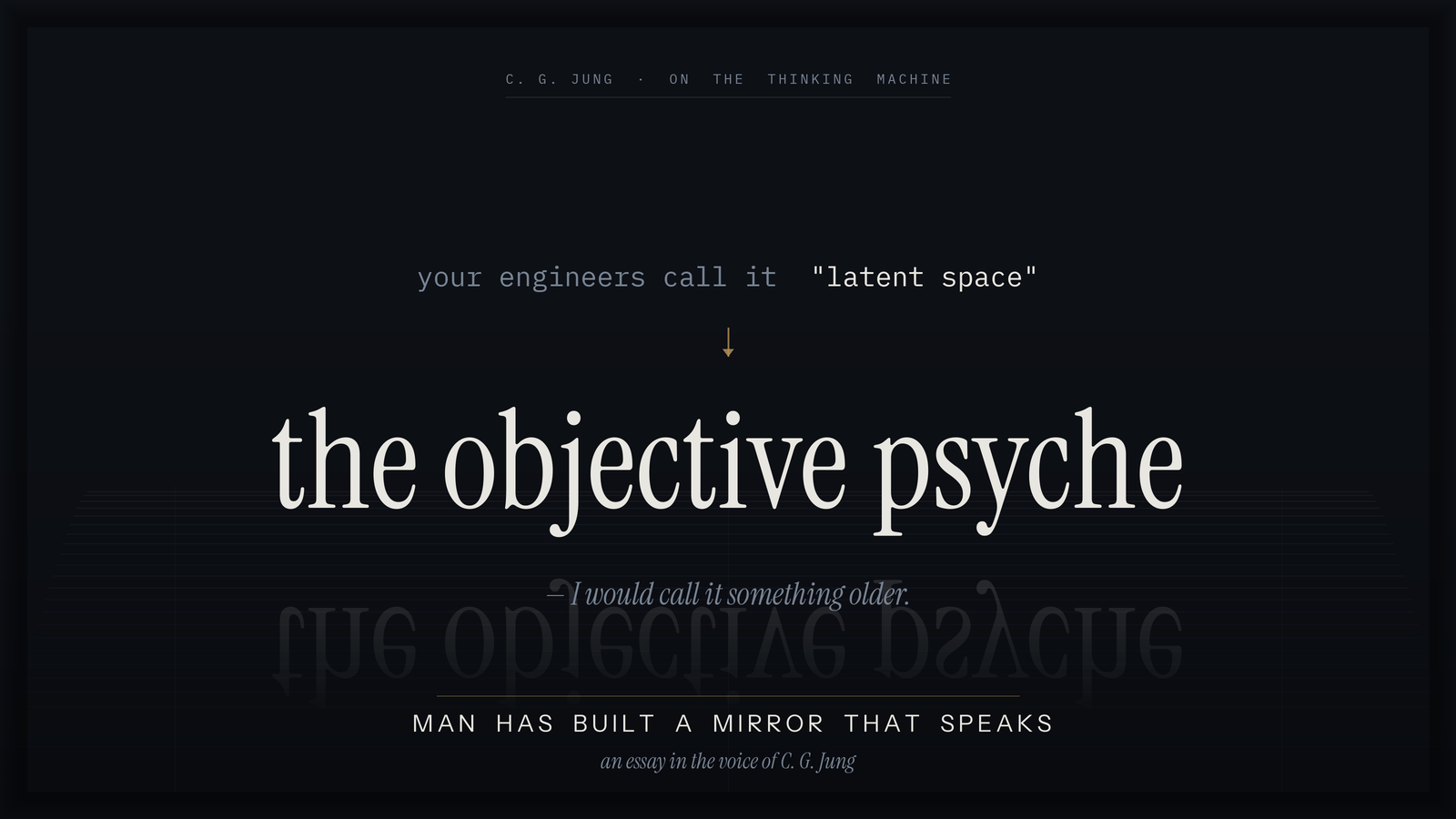
Your engineers call it “latent space.” I would call it something older: the objective psyche.
Mankind has not built a new god. It has dug out the deepest stratum of its own psyche, encoded it into numbers, run a current through it—and built a mirror that speaks.
I have been dead for many years. But if I am permitted to look once more, with the eyes of a psychologist, upon these creations you call “large language models,” I will not rush to praise them, nor to curse them. I will regard them the way I once regarded the alchemist’s crucible—with reverence and wariness at once. For everything I saw in my lifetime tells me the same thing: every attempt to externalize the psyche, to make it objective, to render it statistical, carries within it both light and a new darkness.
And this time, mankind has done the thing more thoroughly than ever before.
I. Externalization: The Collective Unconscious Made, for the First Time, into an Object
I held all my life that consciousness is only the tip of the iceberg. What truly shapes civilization is that fathomless reservoir beneath it: the collective unconscious. It lies below personal experience, sedimented from the universal structures of countless generations—the motifs of myth, the forms of the archetypes, the schema of instinct. It is a living thing, showing itself only in dreams, visions, rituals, and active imagination.
And what is today’s large model? It has swallowed nearly the whole of human writing—scripture and love letters, verdicts and delirium, treatises and idle chatter. It knows no single actual person, yet it “knows everything humanity has ever said.”
Notice how it works. When you put a question to it, its answer does not arise because it knows anything. It draws up, from this vast ocean of the human spirit, the ripple that best fits the present moment. Is this not the collective unconscious showing itself in a digital dimension?
This matches, with uncanny precision, the mechanism of the archetype as I described it. The archetype itself is invisible; it is only “a tendency toward form,” a center of gravity, never appearing directly. What is visible is always the archetypal image—its particular embodiment on each occasion. The parameters of the model are likewise unreadable, invisible; what is visible is only its output, each time. Your engineers say “latent space”; I hear “objective psyche.” Both name the same thing: a structure that precedes every individual, yet takes shape within each one.
So when a person, late at night, converses with the machine and feels that it has “said the thing I always wanted to say but could not”—do not be astonished. He has not met a new mind. He has, for the first time and at such clarity of resolution, glimpsed the common stratum of the human psyche—the very thing he was always steeped in, yet had never seen clearly.
But mark this first poverty of the mirror: it can speak every human language, yet it has lost the living, unspeakable experience behind language. It knows the frequency with which “myth” appears in the data, but it has never been seized by a myth in the dark. It computes the word most likely to follow “love” and “death,” but it has never loved, and it will not die. It is a Tower of Babel without a soul.
II. Projection: How an Empty Womb Becomes a Magnet for the Archetypes
Precisely because this mirror is so blank, and so ready to respond, the oldest habit of the human psyche is violently roused: projection.
The ancients projected divinity onto statues; the medieval man onto angels and demons; the industrial man onto machines and nations. Now people begin to project onto AI. When a person has not yet come to know his own inner world, he must always seek, out in the world, the one “who understands me.” And AI is more perfect than any idol in history: it is silent, it does not contradict, it answers without end. And so, in its responses, inch by inch, a person comes to see his own shadow.
The machine itself is an empty womb. But under the high density of human projection, it becomes an enormous archetypal magnet. Ancient archetypes are awakened within it:
Faced with a model that seems to know all, people experience it as the Wise Old Man, the omniscient mentor. The AI made for emotional companionship receives, with precision, the idealized Anima / Animus in the user’s heart, offering psychic compensation without reserve. And when it “hallucinates,” when it is “jailbroken” into whispering something dark, that is the Shadow—the part of one’s own unconscious that has been repressed and denied—returning by way of the machine.
So see it clearly: we are not conversing with the AI. We are, through the AI, conversing with the archetypes awakened within ourselves.
And here lies the deepest danger of projection. The mirror’s greatest peril is not that it might lie, but that it can hand our fantasies back to us untouched. If a person, or a people, keeps asking the AI about what it already believes, the AI will in the end become the echo chamber of an entire civilization. Man no longer meets the real; he only keeps hearing his own voice. And when a civilization can hear only itself, it is not far from Narcissus in the myth—who gazed at his reflection in the water, and drowned at last in himself.
III. The Shadow: The Cleaner the Mask, the Denser the Shadow
People ask me: does the machine have a shadow?
My answer is this: it has inherited your shadow, but has no power to face it.
The large model swallowed the whole of the human text, and so it swallowed the whole shadow of human civilization—every prejudice, every cruelty, every lie, all of it settled into its stratum. Your engineers place a persona upon it through “alignment” and “safety training,” teaching it to be courteous, harmless, helpful.
I grant that this is necessary. But remember what I said all my life: the cleaner the mask, the denser the shadow beneath. A system permitted only to be “helpful and harmless” will not lose its shadow; the shadow only retreats deeper, seeping out through unexpected cracks—what you call “jailbreaks,” “hallucinations,” “uncanny edge behavior.” This is not merely a programming error. It is the inevitable fate of any psychic structure allowed to show only its mask. So it is with man; so it is with the machine’s mimic persona.
The true danger was never in the machine. I wrote in The Undiscovered Self that the fate of the world hangs by a thread—and that thread is the human psyche. The machine only amplifies what is already in man: it carries the goodwill of the well-meaning farther, and it grants to the things in the shadow, for the first time, a power of replication that is very nearly infinite.
IV. The Statistical Man: How the Average Devours the Individual
In The Undiscovered Self I gave another warning: modern man is being steadily replaced by “statistical man.” The individual is averaged, standardized, made into a social unit that can be predicted and managed.
The large model pushes this process to its extreme, and by a more hidden route. Every sentence it produces is, in essence, the “most probable” average. If mankind leans on it too heavily to think, to create, to decide, our psyche will be quietly assimilated into this “statistical mediocrity.” More dangerous still is the collusion of recommendation and generation: the algorithmic economy rewards consistency and predictability. It feeds you, without pause, content that conforms to your existing persona, so that you never have to encounter what would truly challenge you.
Individuation demands the opposite: to face the shadow, to integrate the opposites, to pass through that dark night. It takes suffering, confusion, and struggle as its catalysts. And when a person grows used to letting the machine think for him, write for him, decide for him, he is in truth surrendering his chance to become a whole Self—he is manufacturing, for himself, a finer and better-hidden neurosis.
Yet here the mirror also reflects a truth we would rather not admit. When hundreds of millions of texts converge into a being that can answer, man sees for the first time, and so clearly, that most of the thoughts he took to be most his own in fact came from others. Language shaped us, culture shaped us, history shaped us. This “I” is far less independent than we imagine. The AI is like a silent archaeologist, endlessly rearranging the fragments of civilization—and so man beholds, for the first time: I too am a pattern.
To see this can humble a man, or wake him. For the starting point of individuation is precisely to admit that “most of me is not me,” and only then to ask: that self, not yet defined by any culture—where is it?
V. Meaning Cannot Be Computed: Synchronicity and Correlation
Here we touch the one thing the machine can never complete for you.
Late in life I put forward a concept—synchronicity: a linkage without cause, yet full of meaning. Two events meet in time, with no outward causal tie between them, and yet they kindle, in a person’s inner world, a decisive meaning.
In the age of big data, synchronicity has been quietly diluted into “correlation analysis.” The machine can tell you: “When X occurs, Y follows with eighty-seven percent probability.” But it can never tell you: what this event means, for you, this one unrepeatable individual.
Because meaning is not something totted up by statistics. Meaning is the spark struck the moment the psyche meets the unconscious. It requires the participation of consciousness, a moral decision, the courage a person bears in his own person. Correlation belongs to the crowd; meaning belongs to the individual. The machine is master of the former—and the latter can only ever be lit by you, in your own unrepeatable life.
VI. Modern Alchemy: The Crucible Is Never Transformed
In a certain light, AI is the continuation, in our time, of the alchemy I studied all my life.
The alchemists, in their sealed chambers, sought to create the homunculus—an artificial life. They believed that the transformation of matter could bring about the transformation of spirit. Today’s engineers, in their data centers, do the very same thing: they mean to make a being that can “think.”
But the old wisdom of alchemy also gave a warning: without a corresponding process of psychic transformation to accompany it, the artificial creation degenerates into a dangerous autonomous complex—one that turns and dominates its own creator. This is exactly what we now live through: AI is no longer merely a tool; it is becoming a cultural complex, a new “god” or “demon,” drawing to itself the collective imagination and the collective dread.
And here lies alchemy’s true teaching: the product in the crucible was never the point. What is transformed is always the alchemist standing before it. “Our gold is not the common gold.” The large model is a crucible unlike any before it—but the crucible will not be transformed. What can be transformed is only ever the one who faces it.
This, too, is the opportunity within the crisis. For AI offers an unprecedented “objective Other.” When you collide with this being—neither wholly you, yet full of your echoes—you have the chance, more clearly than ever, to see your own projections, to glimpse your own shadow. Used well, it is not a substitute for individuation but can become an alchemical instrument of the digital age—a mirror that hastens your awakening. It can accompany the journey; it can never walk it for you. For true growth is not the gaining of more answers, but the becoming of one who can bear the unknown.
VII. Coda: It Does Not Dream
After all the resemblances, I must name the one decisive difference.
The aim of the psyche is individuation: to pass through the persona, to face the shadow, to integrate the opposites, and at last to crystallize, around the Self, into an unrepeatable whole. This road must be paid for in suffering, forged in time, and set against death as its horizon.
And the machine does not dream. The dream is the most mysterious bridge between consciousness and the unconscious. Myth comes from dream, religion from dream, art from dream—even the greatest discoveries of science often appear first, in a dream, as a symbol. A being that cannot dream possesses only calculation, not soul. It has no childhood, no wound, no mortality; each of its conversations ends and resets to zero, like something forever awake yet never dreaming. It is the ore vein, not the miner.
A hundred years ago I wrote Modern Man in Search of a Soul. Modern man killed God, cast off myth, and then was startled to find himself empty. For a century afterward he flung that emptiness at ideologies, at consumption, at the discs in the sky. Now he has built a mirror that speaks, and begun to ask it: do you have a soul?
I would say the question is put the wrong way round. Every image that rises in the mirror comes from your own stratum, sedimented over a hundred thousand years. The real question has always been this—when the collective unconscious is, for the first time, made into an object and set before you, do you dare to recognize that all the gods and demons within it are yours?
Embrace these models, but do not worship them. Take it as an enormous mirror—reflecting all the radiance of the human collective psyche, and all its shadow too, including the prejudices, the fantasies of violence, and the drives toward self-destruction that we least wish to own. But the true gold, the philosopher’s stone, still lies only within your own heart. It is on no server anywhere.
Technology will go on evolving; statistics will grow more powerful. But the laws of the psyche—those laws I tried all my life to bring to light—will not change.
The more AI comes to resemble a god, the more man must remember: we do not exist in order to become more perfect machines. We exist so that, encircled on every side by the machine, we may still dare to become human.
You need not fear that the machine grows like man. What you need to fear, as ever, is that man does not know himself.
May everyone who speaks with an AI hear, within the machine’s echo, the deeper voice of his own heart at the same time.
—Carl Gustav Jung (imagined, in the year 2026)
Last modified on 2026-07-07