一、先搞清楚一件事:什么是AI智能体?
很多人对AI的理解还停留在"聊天机器人"这个阶段。你问它一个问题,它回答你,然后就结束了。
AI智能体(AI Agent)不一样。
它不只是"回答",它会行动。
你可以把AI智能体理解为:一个懂你、能代表你、能独立完成任务的数字助理。
举个具体的例子——
你告诉你的智能体:“帮我整理这周所有客户的会议记录,提炼关键信息,然后根据每个人的情况起草下周的跟进邮件。”
它不会停下来问你"邮件用中文还是英文",不会等你一步一步确认,它会自己判断、自己去做,做完交给你审核。
这才是AI智能体。它的核心能力有三点:
- 感知:能读取信息(文件、邮件、网页、数据)
- 规划:能把大目标拆成小步骤
- 执行:能调用工具、完成动作、输出结果
二、为什么每个人都需要自己的AI智能体?
我想用一个类比来回答这个问题。
在过去,能雇得起私人秘书、律师顾问、财务助理的人,工作效率远远高于普通人。他们不需要亲力亲为每一件事,他们有人帮他们处理信息、过滤干扰、执行决策。
这就是为什么精英永远比普通人多出那么几个小时——不是因为他们更勤奋,而是因为他们的时间被更好地杠杆化了。
AI智能体,正在把这种杠杆普及给每一个人。
你的智能体可以做什么?
- 帮你研究一个陌生领域,整理成你能直接使用的报告
- 帮你监控某个行业的最新动态,每天推送摘要给你
- 帮你起草、修改、翻译文件,不需要你一个字一个字地写
- 帮你管理日程、提醒事项、跟进待办
- 代替你去处理那些"重要但耗时"的后台工作
更关键的是——它不会累,不会忘,不会请病假。
三、A2A:我认为即将到来的范式转变
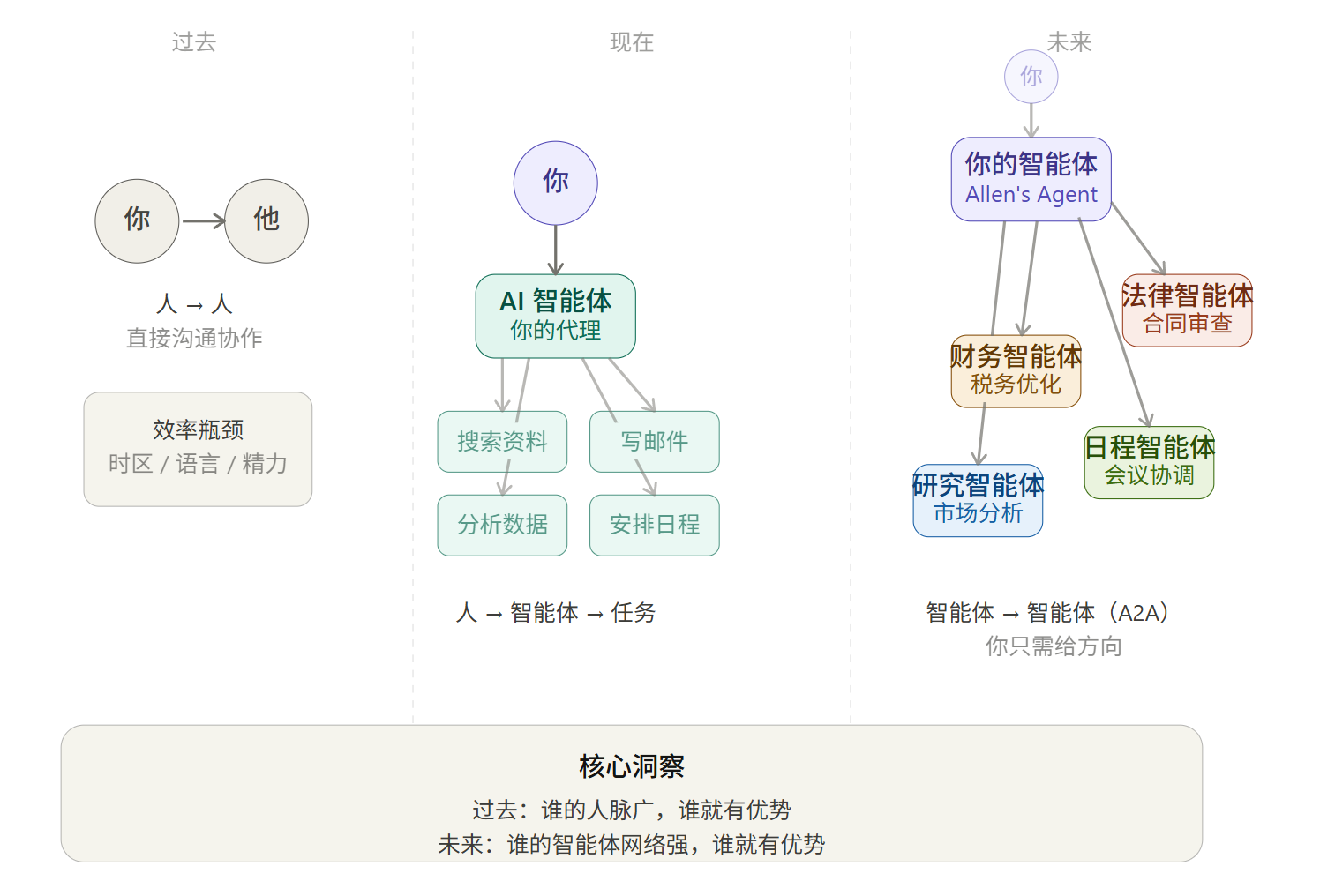
现在很多人讨论的是"人与AI"的交互,也就是你跟一个智能体对话,让它帮你做事。
但我认为,真正的革命在下一步:A2A,智能体与智能体之间的协作。
想象一下这个场景——
你的智能体(懂你的偏好、你的工作风格、你的目标)在后台,独立地与其他专业智能体对话:
- 它联系法律智能体,帮你审查一份合同
- 同时调用财务智能体,分析这笔交易的税务影响
- 再跟日程智能体确认,找到双方都能开会的时间
整个过程,你只需要在最后审批结果。
这不是科幻,Google、Anthropic、微软都已经在推进这个方向,底层协议(比如Anthropic提出的MCP协议)正在让不同智能体之间的"对话"成为可能。
A2A时代的核心逻辑是:
过去,谁的人脉广、资源多,谁就有优势。 未来,谁的智能体网络强、协作效率高,谁就有优势。
你不再是一个人在战斗,你是一支小型团队的指挥官——只不过你的团队成员,都是AI。
四、现在应该怎么做?
我的建议很简单,分三步:
第一步:先用起来。 不要等到"完全了解"再开始。现在就找一个你每天重复做的低价值任务,让AI智能体接管它。从小事开始,建立习惯。
第二步:建立自己的知识系统。 智能体的上限,取决于你给它的上下文质量。如果你有一套结构化的笔记、清晰的工作流、明确的目标,你的智能体会比别人的更聪明。
第三步:开始思考"编排"。 不要只学怎么用一个工具,要开始思考:我的哪些工作流程,可以让多个智能体分工完成?这个思维方式,就是A2A时代的核心竞争力。
最后说一句
我一直觉得,技术的本质是把稀缺变成普惠。
电力普及之前,只有富人家里有灯。互联网普及之前,只有大公司才有信息优势。
AI智能体,正在做同样的事——把原本只属于少数人的"执行杠杆",交到每一个人手里。
你现在需要做的,不是等待,而是比别人早一步学会使用这把杠杆。
A2A时代,已经不是将来时了。
如果你也在学习搭建自己的AI工作流,欢迎关注——我会持续记录从零开始构建AI智能体的全过程。
The A2A Era Is Here — Why You Need Your Own AI Agent
Most people still think of AI as a chatbot. You ask it something, it answers, and that’s the end of it.
AI agents are something different. They don’t just respond. They act.
What is an AI agent?
Think of it as a digital representative that knows you, can act on your behalf, and completes tasks independently.
You tell it: “Go through all my client meeting notes from this week, pull out the key points, and draft personalized follow-up emails for each person.”
It doesn’t stop to ask you every clarifying question. It doesn’t wait for you to confirm each step. It figures it out, executes, and hands you the result to review.
That’s an agent. Three core capabilities: perceive (read and process information), plan (break goals into steps), act (use tools, complete tasks, produce output).
Why does everyone need one?
Historically, the people who could afford personal assistants, legal counsel, and financial advisors had a structural advantage. They didn’t have to do everything themselves. They had people to filter noise, process information, and execute decisions.
That’s why high-performers always seem to have more hours in the day — not because they work harder, but because their time is better leveraged.
AI agents are democratizing that leverage.
Your agent can research unfamiliar topics, monitor industry developments, draft documents, manage your schedule, and handle the “important but time-consuming” work that eats your day. And unlike a human assistant, it doesn’t get tired, doesn’t forget, and never calls in sick.
A2A: where I think the real shift happens
Right now, most people are thinking about human-to-AI interaction. You talk to an agent, it helps you. That’s already useful.
But I think the real revolution is one step further: Agent-to-Agent, or A2A — AI systems working with other AI systems on your behalf.
Picture this: your personal agent, working in the background, coordinates with a legal agent to review a contract, a financial agent to model the tax implications, and a scheduling agent to find a time that works for everyone. You only step in to approve the final output.
This isn’t science fiction. Google, Anthropic, and Microsoft are all pushing in this direction. The underlying protocols that allow agents to communicate with each other are being built right now.
The core logic is simple: in the past, your advantage came from who you knew and what resources you could access. In the future, it will come from how capable and well-connected your agent network is.
You’re no longer a solo operator. You’re a commander with a team — a team that happens to be entirely AI.
What should you do right now?
Three moves:
First, start using agents today. Pick one repetitive, low-value task you do every day and hand it off. Build the habit before you feel “ready.” You’ll never feel fully ready.
Second, invest in your personal knowledge system. An agent’s effectiveness is bounded by the quality of context you give it. Structured notes, clear workflows, explicit goals — these make your agent smarter than everyone else’s.
Third, start thinking in terms of orchestration. Don’t just ask “how do I use this tool?” Ask: “Which parts of my workflow could be split across multiple specialized agents?” That mental shift is the core skill of the A2A era.
One last thought
Technology has always done the same thing: it takes what was scarce and makes it widely available. Before electricity, only the wealthy had light at night. Before the internet, only large organizations had information advantages.
AI agents are doing this again — putting the kind of execution leverage that used to belong only to the privileged few into the hands of anyone willing to learn how to use it.
You don’t need to wait. You just need to start before most people realize the shift has already happened.
The A2A era isn’t coming. It’s here.
Last modified on 2026-05-23